
Introduction

If you are new to blogging, SEO, affiliate marketing, or digital marketing, the first and most important skill you should learn is keyword research for beginners.
Many beginners create websites and publish articles, but they do not receive any traffic. One of the biggest reasons for this is targeting the wrong keywords. Keyword research is the foundation of SEO. If your foundation is strong, your rankings, traffic, and leads will improve significantly.
In this guide, we will cover:
- What Is Keyword Research?
- How to Do Keyword Research
- Free Keyword Research Tools for Beginners
- How to Find Low-Competition Keywords
- Keyword Research for a New Website
- Search Intent
- Competitor Analysis
- Keyword Mapping
- Common Mistakes
- Advanced Strategies
What is Keyword Research?
Keyword research is the process of identifying the search terms that users enter into Google and other search engines.
Example: If you provide SEO services, users might search for:
SEO Services
SEO Expert
Best SEO Company
SEO Agency Near Me
All of these search terms are keywords.
The objectives of keyword research are:
- Understanding search volume
- Identifying competition
- Understanding user intent
- Finding ranking opportunities
Why Is Keyword Research Important for SEO?
Keyword research isn’t just about finding words for your articles; it is the strategic foundation of your entire digital marketing lifecycle. Skipping this step means guessing what your audience wants, which rarely works in modern search environments.
Here is a detailed breakdown of how proper keyword selection directly impacts your website’s growth:
1. Maximizes Organic Traffic Growth
When you align your content strategy with search data, you stop writing blind. You create comprehensive articles around topics that real users are already actively searching for every single day. By targeting high-interest topics, you naturally open a steady floodgate of consistent, long-term organic traffic to your domain without relying on paid advertisements.
2. Accelerates Crawling and Search Engine Rankings
Search engine algorithms rely on clear context clues to categorize websites. Using structured, relevant terms throughout your headings and body text helps crawlers instantly understand the primary topic, semantic depth, and industry relevance of your content. When the search engine perfectly matches your page’s context to a user’s query, your rankings naturally shoot up.
3. Attracts the Right, Highly-Targeted Audience
Driving generic numbers to a website is a vanity metric; what you truly need is targeted visitors. Strategic keyword filtering allows you to filter out broad, unhelpful searchers and specifically attract buyers who are genuinely interested in your exact niche, services, or knowledge base. This ensures that the people landing on your site are the ones who actually need your value.
4. Boosts Lead Generation and Conversion Rates
The natural byproduct of attracting a highly targeted audience is a massive spike in your conversion metrics. Because the traffic landing on your content has high search intent (meaning they are looking for immediate answers or products), they are significantly more likely to sign up for newsletters, download resources, fill out contact forms, or click the purchase button.
Types of Keywords
Deep Dive into Keyword Classifications & Targeting
To run an efficient campaign, you cannot treat all search terms the same way. Keywords are broadly classified using two primary metrics: their structural length and the underlying psychological intent of the user. Understanding these segments helps you decide exactly what type of content to build.
1. Keyword Classification Based on Length
The structure of a search query tells you a lot about how close a user is to making a decision. We divide these into two main buckets:
Short-Tail Keywords (Head Terms): These are broad, generalized phrases consisting of only 1 to 2 words.
Examples:
SEO,Blogging,Digital Marketing,Fitness.Pros: They command massive monthly search volumes and pull in top-of-funnel awareness.
Cons: The competition is fiercely intense. For a fresh domain, ranking for these is nearly impossible as you are competing directly with multi-million dollar authority publications.
Long-Tail Keywords: These are highly specific, descriptive phrases that are typically 3 or more words long. If you are currently learning keyword research for beginners, mastering long-tail variations is your fastest ticket to first-page Google positions.
Examples:
Keyword research for beginners 2026,Best affordable SEO tips for small business owners.Pros: They carry incredibly low competition, clear contextual intent, and drastically higher conversion rates.
Cons: They have lower individual monthly search volumes, meaning you need to target multiple long-tail variations to build substantial traffic networks.
2. Keyword Classification Based on User Search Intent
Search intent represents the core psychological “Why” behind a search query. When executing keyword research for beginners, satisfying search intent is Google’s number one ranking signal. If your content layout doesn’t match what the user is looking to find, your page will drop out of the top rankings.
Here is the strategic breakdown of how search phrases are divided based on intent:
| Keyword Type | Description | Examples |
| Informational | User is looking for answers or basic information. | What is SEO, How to do keyword research |
| Commercial | User is investigating tools or services before making a final choice. | Best SEO Tools, Best Keyword Research Tools |
| Transactional | User is ready to make a purchase or hire a professional. | Buy SEO Services, Hire SEO Expert |
| Navigational | User wants to go to a specific website or brand page. | Google Search Console login, Facebook |
How to Do Keyword Research (Step-by-Step)
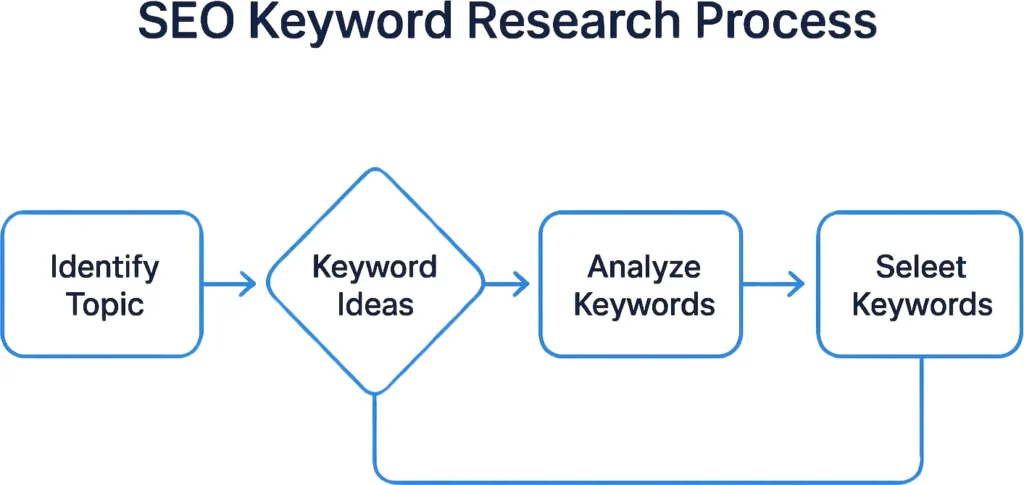
Step 1: Select and Define Your Niche
Before typing anything into a tool, you must clearly identify the core theme, target audience, and industry vertical of your website. If your niche is too broad, you will get lost in the noise; if it is too narrow, you won’t find enough audience demand.
Industry Vertical Examples: Search Engine Optimization (SEO), Digital Marketing, Health & Fitness, Personal Finance, Consumer Technology, or Sustainable E-commerce.
Step 2: Uncover Your Seed Keywords
Seed keywords are broad, short-tail phrases that act as the starting baseline for your deep research phase. If you are starting keyword research for beginners, you must list down your core industry offerings or basic products first to generate these roots.
Core Core Example: SEO
Brainstormed Related Seeds: SEO Tips, SEO Guide, SEO Tools, SEO Strategy for Small Businesses.
Step 3: Leverage Google Autocomplete
Open a clean incognito browser window, type your seed keyword into the Google search field, and carefully look at the drop-down predictions. These suggestions are completely free, real-time, high-volume searches that users are typing right now.
Type into Google: Keyword Research
Live Predictive Suggestions: keyword research for beginners, keyword research tools free, keyword research guide for bloggers.
Step 4: Extract Content Gaps from the “People Also Ask” (PAA) Box
The PAA accordion box on a live Google search results page reveals real questions submitted by active users. This section is a literal goldmine for mapping out a keyword research for beginners editorial calendar, as answering these specific questions builds immense trust and increases your chances of ranking as a featured snippet.
Extracted User Question Examples: What is keyword research?, How do beginners find low-competition keywords?, Is keyword research still necessary?
Step 5: Analyze “Related Searches” for Semantic Variations
Scroll past all the top organic links to the very bottom of the Google search results page. The “Related Searches” cluster provides additional, highly relevant semantic keyword variations. Adding these secondary keywords into your subheadings helps you capture additional search volume alongside your primary focus query.
Best Free Keyword Research Tools for Beginners
When executing keyword research for beginners, you don’t need to invest in expensive paid software right away. Here are the best free tools to get you started:
Google Keyword Planner: Best for official search volume, competition metrics, and fresh keyword ideas directly from Google.
Google Trends: Ideal for identifying trending topics and checking seasonal search patterns.
Ubersuggest: Provides free daily searches covering keyword difficulty and basic competitor insights for keyword research for beginners.
Answer The Public: Visualizes a goldmine of question-based keywords.
Keyword Surfer: A free Chrome extension that displays search volume directly in Google search results.
Google Search Console: The best tool to discover keywords your site is already ranking for and uncover hidden opportunities.
Ahrefs Webmaster Tools: Excellent for free website audits and limited organic keyword insights.
SEMrush (Free Version): Offers limited but highly accurate keyword and competitor metrics daily.
How to Find Low-Competition Keywords

For new websites, finding low-competition terms through strategic keyword research for beginners is your absolute goldmine to rank faster on Google.
Target Long-Tail Keywords: Instead of targeting broad terms like “SEO”, target long-tail phrases like “SEO for beginners”.
Focus on Question Keywords: Use phrases starting with How to, What is, or Why.
Capitalize on Trend-Based Keywords: Write about newly launched tools, updates, or emerging topics before others do.
Identify Competitor Gaps: Find topics your competitors covered poorly or missed entirely, and write better content.
Understanding Keyword Difficulty (KD)
Keyword Difficulty estimates how hard it is to rank on the first page of Google. When doing keyword research for beginners, always check the KD scale:
0–20 (Easy): Perfect for beginners and brand-new websites.
21–40 (Medium): Requires decent content structure and a few quality backlinks.
41–60 (Difficult): Requires highly comprehensive content and strong domain authority.
61+ (Very Difficult): Heavily dominated by giant, established brands.
Keyword Strategy for New Websites
New websites lack domain authority, so your targeting strategy must be highly specific. Implementing a strategic framework for keyword research for beginners will help you uncover hidden, high-converting opportunities.
1. Shift Your Target
Instead of choosing highly competitive, broad terms, shift your focus to longer variations.
Instead of: SEO Services
Target: Affordable SEO Services for Small Businesses
2. Local SEO Keyword Research
If you are targeting a specific geographic location, optimize for local intent. This is one of the most effective tactics taught in keyword research for beginners to get quick organic traffic.
Examples: SEO Company in Delhi, Website Designer in Dwarka, Digital Marketing Agency in Delhi.
3. Optimize for Voice Search
Voice searches are conversational and phrased as complete sentences rather than short fragments.
Typed Search: SEO Services Delhi
Voice Search: Which is the best SEO company in Delhi?
Structure and Architecture
Keyword Mapping
Assign every target keyword to a specific, dedicated page on your website to avoid confusing search engines. For instance, your primary informational guide can be mapped directly to a blog post.
Homepage Digital Marketing Agency
Service Page SEO Services
Blog Post Keyword Research for Beginners
Keyword Cannibalization: Internal Competition
Keyword cannibalization occurs when you write multiple articles or landing pages that target the exact same focus keyword. Many content creators mistake this for “covering all bases,” but it actually forces your own pages to split their authority and compete against each other in the SERPs (Search Engine Results Pages).
How to Fix and Prevent Cannibalization:
Consolidate Content: If you have two weak posts ranking for the same term, merge them into one single, comprehensive master guide.
Implement 301 Redirects: After merging, redirect the old, deleted URL to the updated master URL so you don’t lose existing link equity.
Clear Internal Anchors: Ensure your internal linking anchor texts point strictly to the single page mapped to that specific keyword.
Content Cluster Strategy: Building Topical Authority
Modern SEO in 2026 relies heavily on semantic relevance. Instead of writing isolated blog posts, you should build topical authority using a Hub-and-Spoke model (Content Clusters). This structure signals to search engines that your website holds deep expertise across an entire subject field.
The Core Pillar Page (The Hub): A comprehensive, high-level guide covering a broad topic (e.g., Keyword Research).
The Supporting Cluster Content (The Spokes): Deep-dive, hyper-specific articles targeting long-tail keywords that link directly back to the pillar page.
Example Architecture of a Content Cluster:
Main Pillar Topic: The Ultimate Guide to Keyword Research
Supporting Sub-topic 1: Top Free & Paid Keyword Tools in 2026
Supporting Sub-topic 2: How to Analyze Search Intent for Maximum Ranking
Supporting Sub-topic 3: Step-by-Step Guide to Finding Low-Competition Keywords
Supporting Sub-topic 4: Keyword Mapping Strategies for Complex E-commerce Sites
Common Keyword Research Mistakes to Avoid
When fresh marketers start executing keyword research for beginners, they often fall into standard tactical traps that heavily delay their organic growth. Avoid these critical pitfalls to keep your campaign on track:
Targeting Only High-Volume Keywords: Chasing terms with 50,000+ monthly searches right away means competing with multi-million dollar domains. Start small to build initial momentum.
Ignoring Search Intent: Writing a 3,000-word informational article when the top 10 positions on Google are showing transactional checkout pages. Always inspect the live SERP first.
Keyword Stuffing: Artificially forcing your focus keyword into every single paragraph. Write naturally for human readers first, and use secondary context clues instead.
Skipping Competitor Research: Trying to reinvent the wheel. Your competitors are already ranking for valuable terms; analyze their URL structures to spot immediate content gaps.
Ignoring Internal Linking: Leaving high-quality cluster pages unlinked. If your articles sit in isolated silos without passing internal link authority, search engine crawlers will rarely index them.
Best Keyword Research Strategy for 2026
- Focus on User Intent
- Target Long-Tail Keywords
- Build Topical Authority
- Create Content Clusters
- Publish Helpful Content
- Use Internal Linking
- Strengthen E-E-A-T Signals
The Keyword Research Workflow
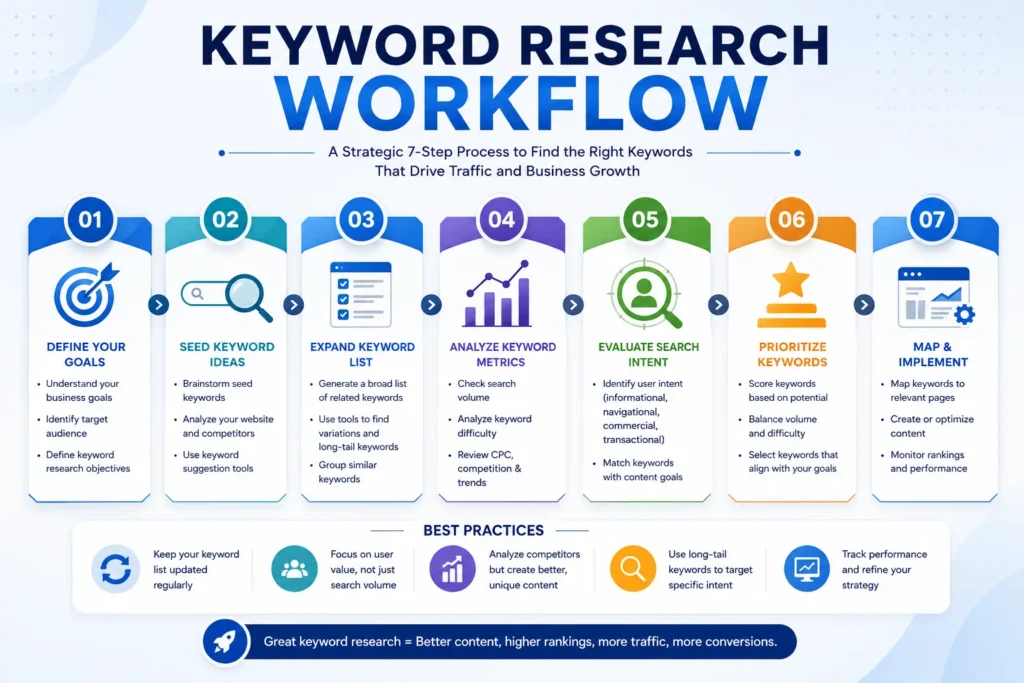
[ 1. Seed Keyword Selection ]
│
▼
[ 2. Keyword Expansion & Discovery ]
(Using Tools, Google Autocomplete & PAA)
│
▼
[ 3. Metrics Filtering & Analysis ]
(Checking Search Volume & Keyword Difficulty)
│
▼
[ 4. Search Intent Audit ]
(Classifying: Informational vs. Transactional)
│
▼
[ 5. Keyword Mapping & Clustering ]
(Assigning Keywords to Dedicated Pages)
│
▼
[ 6. Content Creation & Silo Linking ]
(Writing Helpful Content & Internal Linking)
│
▼
[ 7. Performance Tracking & Audit ]
(Monitoring Rankings via Search Console)
FAQ
Q: What is keyword research?
A: It is the process of discovering, filtering, and analyzing the exact search phrases and queries that users type into search engines like Google. Beyond just finding words, it helps webmasters understand the psychological intent of their target audience, the market demand for a topic, and the overall competitiveness of an industry niche.
Q: What is the best free keyword research tool for beginners?
A: Google Keyword Planner remains the overall best free benchmark tool because its data comes directly from Google’s database. To complement it, beginners should use Google Search Console to monitor their own growing visibility and tools like Answer The Public to discover conversational, question-based variations without any added software cost.
Q: Which keywords are best for a brand-new website?
A: Brand-new websites should strictly target long-tail keywords with low Keyword Difficulty (a KD score between 0–20). Because a new domain lacks historical backlink authority, choosing highly specific, low-competition 3+ word phrases or localized queries allows you to bypass massive industry brands and secure quick first-page placements.
Q: How often should a creator conduct keyword research?
A: Keyword research is a continuous operational cycle, not a one-time setup. You should perform micro-research before writing any fresh article or landing page. Additionally, you should run a comprehensive structural audit of your website’s search performance quarterly to uncover hidden query shifts and refresh outdated content blocks.
Q: Is keyword research still relevant in the era of AI and Search Generative Experience (SGE)?
A: Yes, absolutely. While search engines are getting smarter at evaluating context, keyword research has evolved from simple phrase matching into understanding semantic topical authority and search intent. Search engines still rely on identifying user queries to map out and deliver the most comprehensive information architecture to the reader.
Q: What is the risk of ignoring keyword intent?
A: If you ignore search intent, your pages will fail to rank even with brilliant writing. For instance, if a user searches for a transactional phrase like “Buy premium SEO plugin” and your page serves them a basic, informational history of plugins, they will immediately exit your site. This signals poor user experience to Google, lowering your organic visibility.